Showing posts with label history. Show all posts
    Showing posts with label history. Show all posts

    Thursday, April 25, 2013

    The system design is not our fault. Its perpetuation is our problem.

    I often tell American educators that if we are succeeding with a third to a half of our students, it is only because our educators are trying so hard. The system, after all, was designed and built with the intent to fail 80% of students before 8th grade ended, so we are far exceeding our "design capability."

    I've written lots on this... the most accessible versions here as a One, Two, Three, Four, Five part series on the history of our system. It's an ugly story of a system designed to fail most our children, designed to create compliant factory workers and miners, designed to limit the opportunities for the poor to move between socio-economic classes, and designed to ensure an unchallenged power structure. And for 180 years it has done those things with intentionality, whether the hands on the wheels were Henry Barnard and Ellwood Cubberley, or Bill Gates and Salman Khan.


    From age-based grades and grade-level-expectations, to textbooks, Carnegie Units, chairs and desks, the teaching wall, and the shape of our classrooms, we were handed a set of horrible paradigms - a virtual war against childhood - and asked to somehow lead our nation into a future...

    That's the basic truth, it isn't our fault that our schools are literally built from the ground up to work against us. But, if we are not fighting to change that system every day, from whatever position we hold in education, that is our fault. If we are educators, we begin that profession with a commitment to children, and that is a sacred trust.

    The change needed is radical. It is essential that we redefine almost everything about our schools, which is a very difficult task to undertake, but we have a system that is somewhere between 50 and 120 years behind the curve, and that should promote some urgency.

    Misunderstanding Cognition

    By the time our educational system, whether in the US or the British Empire, was codified and permanized between 1890 and 1910, it was already deeply behind, locked in the Second Industrial Revolution in the United States - the arrival of the railroad, steamboat, telegraph, and mass produced print media - and in the "Second British Empire" in Englland-dominated lands - a place of simply processing the spoils of the colonies. Of course both were already history, as the Boer War had proved to the United Kingdom and the arrival of airplane, cinema, telephone, and phonograph were proving in both environments.

    Whether colonial resentments and migration, or the new cognitive authority of the motion picture, the "sit and git," "same for all," step-by-step filtering system of the educational design was already failing these nations, no matter what racist apologists for the past like Woodrow Wilson might say.

    We know the failure because of the willingness of all these nations to rush into war with no critical thinking from 1898 to 1914 (including the ease of media manipulation). We know the failure because it remained the "non graduates" - from Henry Ford to Frank Lloyd Wright to the Wright Brothers - who dominated the new economy of the time.

    Almost 50 years ago, Polaroid introduces the Facebook, Instagram, SnapChat era.
    Notice that photography is no longer about memory, but is instead an
    instantaneous social connectivity tool. Kids passed dirty pictures too...

    Since 1910 the divide between reality and education has grown exponentially, rushing at breakneck speed over the past fifty years. Schools missed the critical changes even in print literature - from John Dos Passos USA Trilogyin the 1930s to the Beatsin the 1950s to Tom Wolfein the 1960s - and so - contemporary language continues to elude most teachers of the English language. Schools missed the impact of film literature on culture, the impact of visual media in general. Mass media, always minimally and poorly taught, has failed us from Orson Welles' War of the Worlds (really? can't tell news from drama on the radio?) to the Boston Marathon Bombing.

    Schools missed the revolution in interpersonal communications which was created by the telephone, the automobile, the urbanization of the world, and eventually the contemporary technologies of chat, mobile devices, email, Twitter, et al...

    This still horrifying bit of 8mm movie film (not even yet "Super 8") represents a
    key moment in the citizen journalism we all know today. 50 years ago in November...

    Each of these changes, despite what many in education will tell you, alters cognition because it alters cognitive authority - that which allows someone to believe something. We know how quickly this happens too. During the Spanish American War American filmmakers understood the need for people to see "moving images" so clearly that they faked them. Thirty years earlier a "cyclorama" might have been clear truth, now, something else was essential.
    Scholarly material: The Gettysburg Cyclorama seemed
    definitive until film appeared.

    What is truth now? We were all reminded last week that if truth once came from organizations like NBC News and CNN, that's no longer true at all. So how do our students decide if they can trust us?

    If your answer remains, "because I (or the book) told them," it may be time to go, because few will believe you, even if some pretend to for grading purposes. They know that educators lie - they make up silly simplifications because they think kids are stupid. They teach stuff even a casual Google search proves untrue, whether in math or social studies. They make up rules which lack any logic. They divide up subjects and time with no regard to how humans learn. They test in ways which measure nothing important. And thus, in the cognitive authority structure of this century - our students' century - educators, "we," have proven wholly unreliable. And no amalgam of initials after your name or collected diplomas on your wall will change that.

    So we need to doubt everything. Question everything. Engage in "Zero-Based Design" thinking, which imagines that we can start from the ground up, instead of inheriting a dysfunctional structure. And we need to act. As an Iowa superintendent said on Monday, "This is urgent, we can't keep doing this to kids."

    The system is not our fault, but every day we continue to tolerate it is. We need a sense of urgency. For our kids' sake.

    - Ira Socol

    Thursday, April 12, 2012

    Titanic and the Geographies of Language and Moments in Time

    Being sort of "bedridden" (a great old term in itself), gives one time in interesting ways. One way I've been using that time is to listen to audio books. And one of the books - before it descended into a mud-like boredom - was Stephen King's novel 11/22/63.

    Even in 1970, there were more Howard
    Johnson locations in America
    than
    McDonald's, Burger King, and Wendy's
    combined (advert, 1960)
    I loved the first 40% of the book. For me it began as the "best" of Stephen King - the wondrous storytelling capabilities of his short stories, novellas, and early novels - Carrie, The Shining, Christine- without the ponderous self-importance of his later works, including this one. OK, sure, the man desperately needs an editor to clear out 35% of his words (or 50% in his last 20 years of books), but this began as classic - fabulous - Stephen King. Second, it is historical fiction, and well done historical fiction is, for me, an incredible chance to learn in a truly beautiful way.

    Historical fiction can be both bad history and bad storytelling (see Newt Gingrich), passable history and bad storytelling (see Morgan Llywelyn's ponderous Irish Century Novels), or great storytelling with emotionally accurate but event-confused history (Jack Finney's Time and Againis my favorite in this group - nothing will describe 1880s New York City to you in better ways, but I wouldn't set my clock with its specific accuracy). But at its best historical fiction can teach the past in ways history books usually cannot, and in ways school curricula - common or not - can rarely touch. From Finney's descriptive conversation with a late night horse trolley driver circa 1883, to Thomas Mallon's incredible visit with a female computer at the U.S. National Observatory in 1877, or his view of re-burials for US war dead in 1948, or his description of Grand Central Terminal in 1962, this genre offers a sense of place simply unavailable via date memorization, or any "great man, great moment" textbook history. Why? Because understanding history - actually understanding it - requires comprehending the motivations and fears of the people of a time. It is all about empathy. We talk a lot in history classes about stuff like the 1914 assassination in Sarajevo, but nothing of the mood in Europe which would find dominant Socialist parties in both Germany and France to ignore their belief systems and vote for war, and nothing of the middle class sensibilities in almost all European nations which provided cheering throngs for those war votes. For that concept you'd have to, at least, go to Remarque's All Quiet on the Western Front, a novel.

    What did people in 1960 fear?
    How did that impact daily life?
    We might read a lot about America's internment of Japanese citizens, even debate the legality and morality, but a much finer understanding comes with Snow Falling on Cedars. And thus, one-third of the way through King's latest, I will say that his meticulously drawn portrait of hardscrabble upper New England as the Eisenhower administration drifts toward an end, is a brilliantly taught lesson. The world of the grandparents (or great-grandparents) of our current students, the fears, the hopes, the mills, the factory labor, the environmental destruction, the casual-out-in-the-open discrimination, the ways information spread, the quite specific class distinctions, is so vanished now that it is impossible to explain the Vietnam War and how it began to our students.

    King uses a term in his book. He speaks about the "geography of the language" of 1958, and of how his character needs to learn this to succeed in his missions. In Finney's Time and Again there are long courses in these languages and cultural norms for time travellers. This is essential stuff. Humans make decisions based on their knowledge and environments. If we want to be able to explore and understand history, we need to know less about dates, less about "big events" perhaps, and much more about "life."

    Language comes from culture, of course, but it also controls culture. So the Geographies of language matter a great deal. New Yorkers, for example, denote distance in time - "I live 80 minutes out on the Island." "I live an hour north of the city." - which makes sense in a place where there is no specific correlation between miles to travel and any expected trip's length. People in Michigan always - always - hold their right hand up to you and point with a finger from their left hand to indicate where someplace is. People in Seattle wake up to weather forecasts suggesting "sunbreaks" and, on the best possible days, "the mountain is out." One of the great challenges of writing historical fiction is creating dialogue which sounds real and of the time while still maintaining contemporary reader understanding. Another is to describe a "foreign" world to readers without stumbling into the trap which creates bad science fiction - pausing to explain details every other paragraph.

    The Histories of the Moment

    A group of enticing historic anniversaries have collected over this first half of 2012, and this creates an opportunity to use the "geographies of language" to not just offer deep understandings of the past, but to combine that with work which just might improve empathy.

    The RMS Titanic sank 100 years ago. The New York Mets were "born" 50 years ago. Queen Elizabeth II of the United Kingdom has reigned for 60 years. The first battle between "ironclad" warships occurred 150 years ago. The first K-mart opened 50 years ago, creating new kind of "discount store" chain. Humans reached the South Pole for the first time 100 years ago. Telstar, the world's first communications satellite went into orbit 50 years ago, and AT&T demonstrated phones with buttons to push instead of a rotary dial at Seattle's 1962 World's Fair.

    Also in 1962, the Cuban Missile Crisis brought the world to the brink of nuclear war, and Ahmed Ben Bella finally led Algeria to independence from France (which was kind of like if Hawaii, or maybe California, decided to re-assert its independence from the United States). 150 years ago US President Abraham Lincoln signed two laws which brought the government deeply into the lives of many Americans - the Homestead Act granting land in the west, and the Morrill Act which began government support for "Land Grant Universities" like the pioneering State Agricultural College in Michigan (Now, Michigan State University).  Yes, Lincoln also signed the Emancipation Proclamation, though it did not impact slaves in the Union States of Kentucky, Missouri, Maryland, or Delaware. Lord Byron defended Luddite violence against new technologies 200 years ago.

    The Battle of Algiers offers a documentary style visit to Algeria as the revolt builds,
    the flip side, France in 1962, is shown in
    The Day of the Jackal
    And 25 years ago, the Commodore PET and the Apple II ushered in a new world of "computers in classrooms."

    But how can we understand these moments in time unless we understand the worlds in which they occurred? What would you need to know to comprehend just how radically left the early Republican Party was so you might begin to grasp just how huge it was that the Morrill Act created real federal involvement in education? What must you understand about the world of 1912 to appreciate the fact that - despite "women and children first" - a first class adult male passenger was far more likely to survive the Titanic's sinking that a steerage class child? What might you need to understand about phones in 1962 to appreciate the possibilities inherent in Telstar and "Touch-Tone."

    History is a disconnected, meaningless, series of memorizations unless it is built into a real context, and that context requires understanding the various geographies of a time, starting with the geography of the language. Let me offer one example: Working with sixth graders last fall, we were talking about Yuri Gagarin's moment as the first human in space. Students were fascinated, but immediately confused by two things - first - why didn't the US celebrate this amazing moment? and why hadn't their school talked about the recent 50th anniversary of this flight? And second - why were there these long periods when this first Cosmonaut was unable to communicate with anyone on earth?

    How would kids understand the "space race" having grown up in a world where the US has become dependent on Russian technology to simply get into space? How would they understand the limited range of "tracking stations" living in a world where no one is ever "out of range." Truthfully, these sixth graders had no idea what "Soviet Union," "USSR," or "CCCP" ("ess-ess-ess-air") meant.

    Likewise, there is a wonderful moment in Jack Finney's time travel novel, Time and Again, when the protagonist realizes, for the first time in his life, that Manhattan is truly an island. In 1882 New York, the only bridges link to Westchester County (or recent city annexations) across the Harlem River, unless you count the catwalk over the towers of the emerging "New York and Brooklyn Bridge." If he wants to escape the city police he either has to travel seven miles north to Kingsbridge, or he has to risk a ferry crossing when cops are undoubtedly looking for him there.

    1960, the only radio was in the car...
    Or, in my personal experience, I can remember reaching the end of my Police Academy time, and now sure I was passing all subjects, I began listening to a novel, The New Centurions, on the subway instead of law books. In the book there's this moment, at the start of the 1965 Watts Riots, where the LAPD officers fight their way back to their "black and white" so they can call for help. Why, I wondered, didn't they just call on their "portables"? It took me quite awhile to realize that in 1965 handheld police radios did not exist. Police cars were truly "radio cars."

    So, in the 1912 world where "electronic communication" (if the word electronic yet existed) meant the telegraph (wired or wireless), would students think that communications were private? Would they think phone calls were private in the years before the dial was introduced? How long would it take to send a letter from, say, the Lower East Side of New York City to a rural village in the west of Ireland? Why were all those people in steerage? What was life like in Italy, Ireland, or the lower class areas of England? What did they know of the America they were headed to?

    And what of the technology? Would the Titanic really have been racing?  Or did everyone already know that this ship, which had a twin already in regular service, could never go as fast as Cunard's RMS Mauretania? How well did wireless telegraphy work then? When the Titanic became the first ship to send the new S-O-S distress call, who heard it? Why was S-O-S chosen?

    In Nacht und Eis, the original Titanic film telling, 1912 (Germany), US release 1913.
    You can also watch
    The Atlantic, a 1929 film from Britain, the first "talkie" Titanic.
    Below: RMS Carpathia passes Sandy Hook as it enters New York Harbor with the survivors of the Titanic.
    A 1912 Newsreel - most footage is of RMS Olympic during the summer of 1911
    which is obvious from the Captain wearing "summer whites"


    Woolworth's was the
    center of most US
    "Main Streets"
    Knowledge of a time includes many things. Some are very small... What does "RMS" mean? If you heard the name "Titanic" or "Carpathia" would you automatically know which steamship line owned which ship? In 1952 how did news of King George VI's death travel? How was the Princess/Queen Elizabeth travelling? What did stores look like in 1962? What did food taste like if you were in an army in 1862? Some are big... What did the British Empire/Commonwealth look like as Elizabeth ascended to the throne? In 1862 who went to college? Why did the early Republican Party so favor what we might now call "big government"? Why didn't "the Union" outlaw slavery? How did Americans learn to fear "communism"?

    These details, big and small, and millions of others, begin to explain the motivations which drive the actions of those participating in historic events. Why would "housewives" of 1962 abandon their main street department stores and local Woolworth's and Kresge's to drive out of their way to shop at K-mart? Why did men accept "women and children first"? (if they did), or why did that not apply to 1912's poor? Why did so many immigrants from Ireland join the US Army almost before they left the dock in New York? What was it like to turn 18 in 1952 America - especially if you were male?

    Above: The funeral of His Majesty, King George VI of Great Britain, 1952
    Below: Elizabeth is proclaimed Queen
    Below: New York City, 1952
    and London in 1952, from an Italian film
    or, selling cigarettes, 1952

    So phrases like "1-A," "cold war," "Soviet," "empire," "trans-Atlantic," "telephone," "immigrant," "college," even "shopping," suggest different things in different moments of history.

    When Walter Lord, after interviewing the Titanic's survivors in the early 1950s, wrote, "Tonight the problems [of ship designer Thomas Andrews] were typical—trouble with the restaurant galley hot press . . . the coloring of the pebble dashing on the private promenade decks was too dark . . . too many screws on all the stateroom hat hooks. There was also the plan to change part of the writing room into two more staterooms. The writing room had originally been planned partly as a place where the ladies could retire after dinner. But this was the twentieth century, and the ladies just wouldn't retire. Clearly, a smaller room would do." what was he suggesting about the changes in upper class society? What about changes in sex lives? Did upper class changes lead or follow the changes in lower class relationships?

    Ancient gas station on the former US-31 in
    Norton Shores, Michigan
    Lord, who has always been special to me because an Aunt of mine was his secretary as he preserved these memories, works hard in A Night to Rememberto create some of this background, "The things people took with them showed how they felt. Adolf Dyker handed his wife a small satchel containing two gold watches, two diamond rings, a sapphire necklace, and 200 Swedish crowns. Miss Edith Russell carried a musical toy pig (it played the Maxixe). Stewart Collett, a young theological student traveling Second Class, took the Bible he promised his brother he'd always carry until they met again. Lawrence Beesley stuffed the pockets of his Norfolk jacket with the books he had been reading in bed. Norman Campbell Chambers pocketed a revolver and compass. Steward Johnson, by now anticipating far more than "another Belfast trip," stuck four oranges under his blouse. Mrs. Dickinson Bishop left behind 11,000 dollars in jewelry, then sent her husband back for her muff," because this says a great deal about the humans involved. Far more than spending three hours watching Kate and Leo be 1997 types dropped into a 1912 event. 

    But how to build this? A Virginia high school librarian told me that she had her kids read All Quiet on the Western Frontwhile wearing wet socks and sitting on the floor next to overturned tables which created "trench walls," a brilliant start. Perhaps you could have kids take a road trip "the old way" - avoiding the interstates and motorways - to offer some sense of life in 1952 or 1962. Looking closely, you'll find the remnants of old shopping centers, gas stations, and "Motels" along these routes. Or use YouTube to pull up a night of television. Or, using the old "city directories" in your local library (these often pre-dated phone books and listed residents and businesses both alphabetically and by address) to virtually recreate a map of your community in 1912, 1952, 1962.

    40 years ago, NBA All Stars vs. ABA All Stars at the Nassau Coliseum
    Below, US automobile television commercials

    Finney suggests that if his characters want to time travel they must know enough of the minutiae to recreate the past in their memory. That they must know the color of the streetlights (very different in my childhood than now) and what the trolley fare would be, and who was president, and - in a general way - what people ate for dinner. I think he is right, and for history to be anything more than meaningless, we need a little bit of time travel, we need enough empathetic skills to imagine the lives of others who are unlike ourselves.

    So make room for real history. Use these big anniversaries as paths to the past. It will not just build rel knowledge of history, it will build skills which really help our current world.

    - Ira Socol

    Wednesday, September 7, 2011

    September 11, 2001: Knowing History

    Teaching "9/11": Why? How? (The New York Times Learning Network)   
    Remembering September 11, 2001
          Iconic Absence       History Remembered, History Forgotten

    Lessons developed with Dr. Pamela Moran - Albemarle County Public Schools
    with thanks to
    The New York Times Learning Network - Holly Epstein Ojalvo and Katherine Schulten

    The United States participated in the division of Arab regions between the
    United Kingdom an France after World War I. Arab armies had fought
    with "the allies" for their freedom, but they became colonies instead.
    Looking at "9/11" requires us to look at how "we" - whoever "we" may be - nationally, ethnically, individually, choose to see history. Is our history broadly understood? Or seen through a narrow focus? Is our history important? Or is it a peripheral issue, and not essential? Do we accept that history is stories - often conflicting stories? Or do we insist that history is facts and dates?

    Historians have been known to say, "The problem with Americans is that they don't know history; the problem with Europeans is that they do." By this they mean that Americans repeat mistakes because they forget about the past and its lessons while Europeans too often continue fighting over things that happened long ago.


    After the attacks of September 11, 2001 some criticised the “ignorance” of Americans in regard to their role in the Middle East. Everything from Woodrow Wilson’s support for the Treaty of Versailles (which divided the Middle East into French and British colonies at the end of World War I), to American policy towards Israel, to the activities of American oil companies was brought up. In Europe, most students do learn about the troubling actions of their nations in the world. Students in England study what happened when Britain ruled Ireland and India. French students learn about Algeria. German students learn about that nation’s actions during World War II. American history classes, however, usually do not spend much time on America’s colonising past.


    To show a couple of examples, American students rarely learn about the nation’s war against Philippine independence at the turn of the 20th Century
    - or about how the United States came to control Hawaii - but Hungarian students do learn about the Treaty of Trianon -
    and Serbian students do learn about the Battle of Kosovo.
    "The Dismemberment of Hungary" 1919 - Secret Treaties made with
    Romania and Czech nationalists by the French and Americans
    during the First World War resulted in vast Hungarian populations
    being shifted to other nations in the Treaty of Trianon
     
    Does emphasizing certain historic events affect how a nation behaves in the world? Does it impact the citizens of that nation? Do you think Serbians should stop worrying about a battle lost 700 years ago? Should American be more aware of the Philippine-American War? If those changes were made, what might change?

    Students might want to investigate the incidents above, or they may want to go further and investigate some other “memory,” lost or fully recalled, and consider what is impacted by the memory or the lack of it.

    What have our students learned about the United States, Great Britain, and France and their interactions with the Arab world? What have they not learned? Do gaps in knowledge contribute to conflict? Do gaps in knowledge prevent  resolution of conflict?
    Resources


    Philippines
    "Uncle Sam" as a school teacher trying to catch
    Emilio Aguinaldo, the Filipino Independence
    Leader - represented in this 1902 cartoon as
    a misbehaving African-American child.
    http://www.nytimes.com/learning/general/onthisday/harp/1230.html
    http://fototime.com/5F295538D5D5869/orig.jpg 
    Pictorial History of the Philippine War   
    Philippine War from the University of Hawaii

    Hawaii 
    United States "ready to annex Hawaii" from The New York Times   
    US annexes Hawaii 1898, from The New York Times Learning Network
    President Grover Cleveland opposes Hawaiian annexation (1893)  

    Hawaiians celebrate Grover Cleveland (2010)
    Hawaiian Independence Action Alliance

    Trianon
    Hungarian Assembly accepts our peace. The New York Times
    "Romania Still Persecutes Hungarians" The New York Times (1990)
    Hungary's Tragic Century The New York Times (2003)
    The Treaty of Trianon (Text)

    Serbia and Kosovo
    A Bitter Struggle in a Land of Strife. The New York Times Learning Network
    Between Serb and Albanian (Book Excerpt)
    Kosovo declares independence The New York Times (2008)
    The Battle of Kosovo (Images)

    - Ira Socol

    September 11, 2001: History Remembered, History Forgotten

    Teaching "9/11": Why? How? (The New York Times Learning Network)   
    Remembering September 11, 2001
          Iconic Absence       Knowing History
    Lessons developed with Dr. Pamela Moran - Albemarle County Public Schools
    with thanks to
    The New York Times Learning Network - Holly Epstein Ojalvo and Katherine Schulten


    One way of looking at the history of September 11, 2001 is to look at how history is constructed. Some events which seemed huge in their time become forgotten. "VJ Day," the day that Japan surrendered to end World War II was a massive holiday when it happened, but now very few in the United States or Great Britain could name the date.
    On the other hand, sometimes an event which goes un-noticed at the time it occurs becomes mythic. Birthdays of famous people are one example. So history is a question of storytelling. And to explore this, here are six historic events groups of students might explore.


    Exploring the creation of history...


    The stories of September 11, 2001 are very recent in the minds of most Americans, and they are still being formed in political and cultural debate, but other attacks and catastrophes from times past might give us clues to how history is created through storytelling.


    How do we understand a previous event or why is an event no longer recalled? Might the event have impacted your community in some way, or the families of other students? How did things change or not as a result of the event? If we were writing history, how would we decide whether to include the event? If not, why not?

    In our groups we will consider and investigate how the stories of these other events were “constructed” and how those stories have changed - in the telling and importance - over time. Do different groups within the United States remember those events differently, and how do those differences affect the way we think and what we do? As individuals and as a community or a nation?
    The design of the National 9/11 Memorial at the World Trade Center.
    The memorial is currently under construction. Pools with waterfalls
    mark the centers of the location of One and Two World Trade Center
    What kinds of questions can we ask about these events? How will we research how such events might have touched their own families and community? How will we tell the stories we learn to all the other students, from different places, in our groups?

    We will start to explore the past as historians do. We will begin by looking for stories and images from the time of the event, and then we will look for stories told afterwards. You and your groups will begin to decide whether what you find is reliable and confirmable (verifiable) information, not just an opinion. You will try to find out about the authors of the stories. Why did they tell or write these stories?

    We will think about all of ways that events are recalled, and we can do this by accessing global news sources. Newspapers carry many kinds of stories around big events, including retrospectives. Comparing what seemed important on the day an event was first reported with coverage years later will help us build a sense of how history is written, and how that writing changes over time
    .

    Moment 1


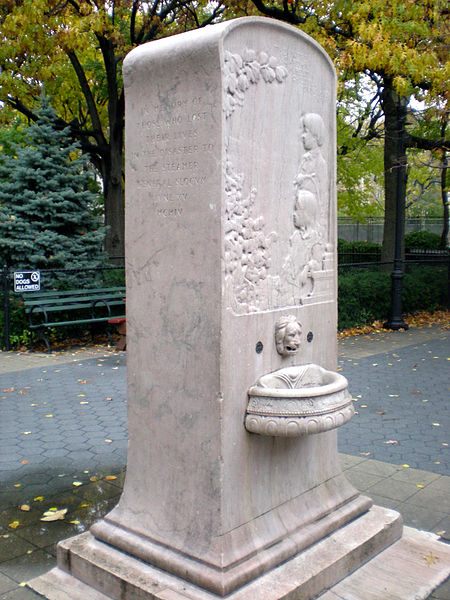
    General Slocum Fire. 1,021 died on June 15, 1904 when an East River (New York City) excursion steamboat, filled with church group family picnickers, caught fire. This fire caused people in the United States to think deeply about safety in public transportation.

    Wikipedia Popular Culture General Slocum Articles 
    (portrayals of event in books, films, etc)
    On this Day
    The New York Times Primary Source  


    Manhattan Melodrama
    (1934 film including fire on this ship)


    Above: The General Slocum in New York City's East River
    Above: The General Slocum after the fireBelow: the New York World

    Moment 2


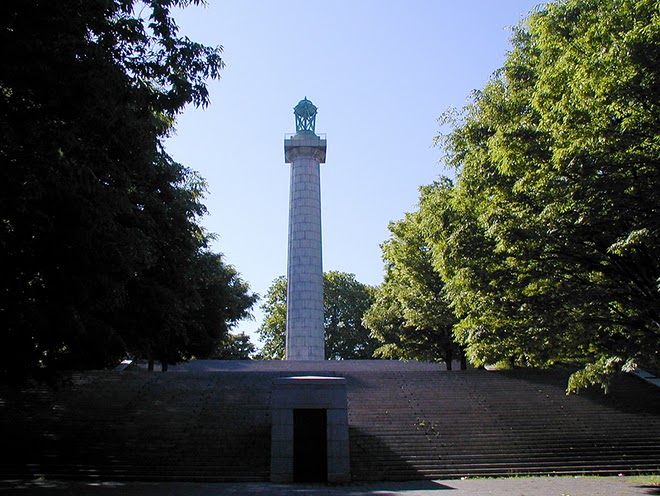
    The Prison Ship Martyrs. Over 11,500 American soldiers and sailors who had been taken prisoner during the Revolutionary War died in what were early “death camps” aboard ships in Wallabout Bay on the East River in Brooklyn (what later became the Brooklyn Navy Yard). Anger in New York was so great that New Yorkers celebrated the day British troops left at the end of the Revolutionary War for more than 100 years (until the beginning of World War I). To celebrate they burned British flags.
    (image: the Prison Ship New Jersey)

    The New York Times on Prison Ship Martyr’s Bones (1908)
    The New York Times on History of the Prison Ship Martyrs (1900)
    The New York Times Remembering the Prison Ship Martyrs (2008)
    The New York Times Student Connections

    Video of Prison Ship Memorial (YouTube)


    Prison Ship Martyrs’ Monument, Fort Greene Park, Brooklyn, NY

    Above: Wallabout Bay showing the shore around the time of the American Revolution (can you find the current area on Google Maps or Google Earth?).  Below: The Brooklyn Navy Yard around 1850 (can you find pictures of "the yard" during World War II?)

    Moment 3

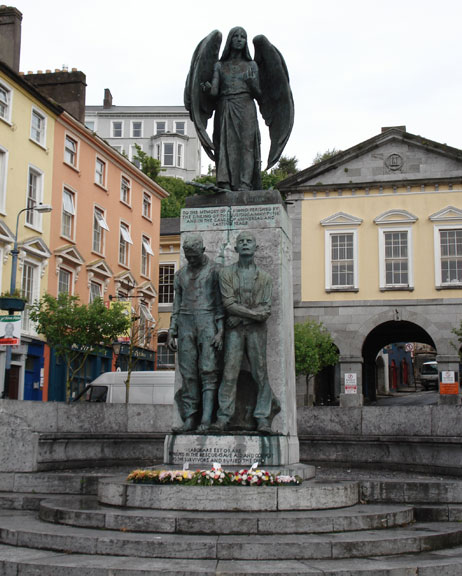
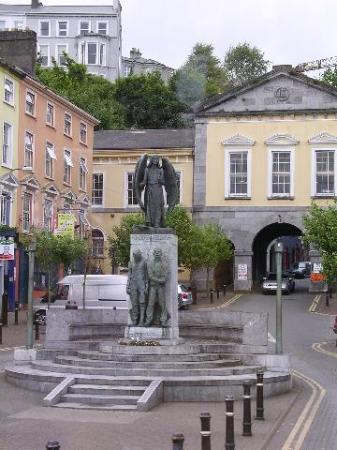
    RMS Lusitania
    . 1,198 people, including 128 Americans were killed when a German submarine torpedoed the British ship Lusitania near Ireland on May 7, 1915. The ship had been travelling from New York to Southhampton, England. The sinking had a major impact on American opinion about the “Great War” going on in Europe, and indirectly led toward US involvement in World War I beginning in 1917.
    The New York Times
    front page from the day after the ship sank
    .   

    American Memory from the Library of Congress


    Video about Sinking of the Lusitania (silent short film, 1918)


    Above: the Warning issued by the German Embassy in Washington, DC before the sailing.  Below: the Lusitania, the world's fastest ship (of the time) in a postcard
    Below: A 1916 newspaper diagram of the sinking

    Moment 4

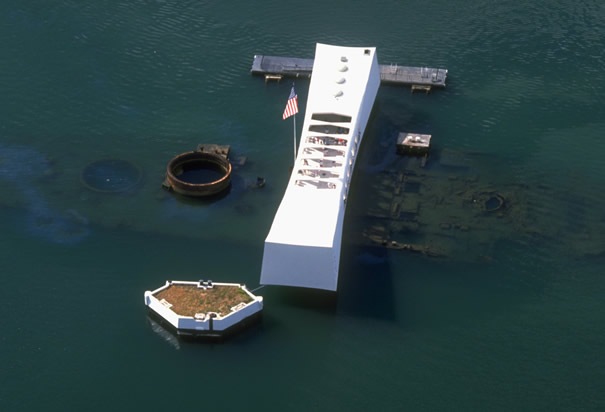
    Pearl Harbor
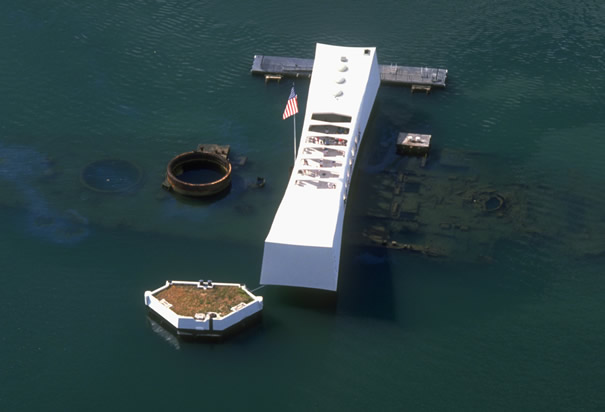
    . 2,402 Americans, mostly military personnel, were killed in an attack by Japanese aircraft on Honolulu, Territory of Hawaii, on December 7, 1941. Within 24 hours of this attack two other US Territorial Possessions were also attacked by the Japanese Navy, Guam and the Philippines. These attacks and Japanese attacks on British controlled territories in Asia linked the Japanese wars against Korea and China to the war raging in Europe since 1939 and created “World War II.”

    The New York Times front page (December 8, 1941)
    FDR Speech December 8, 1941 
    Pearl Harbor Wikipedia Entry  


    Pearl Harbor (YouTube movie, 2001 excerpt)


    Above: USS Maryland (left) and USS Arizona (right) on December 7, 1941
    Below: Ships at Pearl Harbor December 7, 1941


    Below: New York World-Telegram December 8, 1941
    Moment 5

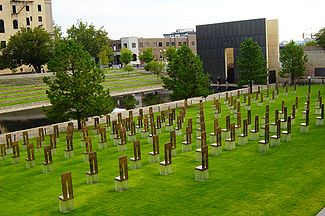
    Oklahoma
    City
    . 168 Americans were killed on April 19, 1995 when two American citizens, men with extreme views about the government exploded a truck bomb outside the Alfred P. Murrah Federal Building.

    The New York Times front page
    (April 20, 1995)
    Presidents Speak to National Tragedies
    : Johnson, Reagan, Clinton, Bush, Obama (The New York Times video footage)
    The New York Times Bill Clinton 15 years later
    (April 18, 2010)


    Above: heavy equipment brought to search through the rubble in Oklahoma City Below: the Baltimore Sun April 20, 1995

    Below: Timothy McVeigh

    Moment 6

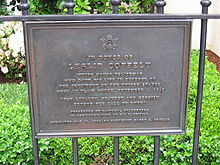
    The Attack on Blair House
    . A White House Police Officer was killed when two terrorists attacked the temporary home of President Truman on November 1, 1950. This assault on the American Executive Mansion (the White House was being reconstructed at this time and could not be used) was conducted by people seeking full independence for the United States’ Commonwealth of Puerto Rico.

    The New York Times
    Attack on President Truman
    (November 1, 1950)

    Wikipedia Entry on Blair House Attack
      

    Protest at the White House
     

    The New York Times
    Remembers Attackers of Blair House
    (February 23, 1994)


    Attack on President Truman at Blair House (newsreel, November 1, 1950)

    Above: Blair House in 1951
    Below: One of the attackers lies dead

    How will September 11, 2001 be remembered in 50 years? in 100 years? in 200 years? In 2111 will people wonder about the memorial now being built?

    - Ira Socol

☝