Showing posts with label disability rights. Show all posts
    Showing posts with label disability rights. Show all posts

    Monday, April 30, 2012

    BADD 2012: Toppliing Transactionalism

    "Happy Birthday Vivian?" I ask. "Why would anyone put up a poster like that?"
    "Vivian?" the response is somewhat incredulous. "What are you talking about?"
    I point through the windshield. She follows my finger and stares. Then, because, well, we've been together a long time, "Oh no," she laughs, "those are candles! not letters, birthday candles!"

    Ahh, the entertaining world of dyslexia.

    Less entertaining might be a few recent wheelchair experiences. A DoubleTree Hotel (slogan: "cookies instead of service") in Roanoke, Virginia with no curb cuts near entrances, unnavigable ramps which changed slope suddenly, and a stage for me to speak from which prevented any physical interaction with those who had come to hear me speak. Or, sitting at the freezing cold plane ends of jetbridges because Rahm Emanuel's City of Chicago can't be bothered with timely responses to wheelchair requests at O'Hare Airport. Or, whether a restaurant in Roanoke or Michigan State University's campus police station, facilities whose "accessible" doorways feature thresholds so high and steeply cut that wheelchairs become stuck - if you're lucky - or you get tossed to the ground - if you're not.

    But equally less entertaining are the millions of classrooms in which student movement is considered a problem. The millions of classrooms without student seating choices. The millions of classrooms without Text-To-Speech and Speech-To-Text routinely available. The millions of classrooms where cultural diversity in learning is sacrificed to the corporatism of the "Common Core."

    And, I suppose, particularly less entertaining are the many places, from schools, to restaurants, to education PhD programs, where people with "disabilities" have to declare themselves pathologically damaged and beg for help in order to be allowed to pretend to function like "normal humans."

    I believe in "Transactional Disability," a spin on Tom Shakespeare's great work linking the social and physical models of disability. To me, there is no actual "disability," there is only "able" and "unable," which are sometimes stable, but more often a constantly changing state of affairs - based on age, health, sleep patterns, energy levels, weather, the day of the week. "My ability to walk has been rapidly improving since my last surgery, but last Thursday the pain was really beyond my tolerance." "I thought I was reading pretty well Sunday, but when we got to the restaurant, and the menu was in ALL CAPS, I couldn't read anything."

    "Able" equals, I can take care of it myself. "Unable" means I need help or tools. Those are basic human conditions, and no one should ever require a special permit, or a costly medical examination, or distinct permissions, to use the tools, or get the assistance, they, as equal children of God, need to function in their lives.

    Whether you choose to take an elevator instead of the stairs, or you need to put on eyeglasses,
    or you need to listen to text instead of "reading" (text-decoding) it - or watching
    a video, or whatever... is a personal decision, not a societal prescription
    The difference between "ability" and "inability" lies in the "transaction space." And "transaction space" is an ever-changing location. My living room is a different "transaction space" today than it was two months ago. The room, of course, is much the same, but where I can go in it, and where I am willing to go, are very different. The same classroom which may be fine for the "average," compliant, calm person, may be a nightmare for me. As I often say, the story of my friend Melissa and her son represents this perfectly: In the daytime, crossing a street, he is "visually impaired," and needs a cane and often assistance. But at night, as they walk around the lake, he is able to navigate perfectly, while she needs a flashlight/torch and often assistance.

    A film is the easiest of transaction spaces for me to navigate in terms of literature, a print-on-paper book is the most difficult. A three-story high urban chain-link fence was a fine transaction space for me when my PF Flyers fit easily between the wires, now it would be an impossible barrier. I will never be able to reach the top shelf in the supermarket without some tool or strategy - that transaction space becomes otherwise impossible.

    (Above and Below): fence... book... paths or barriers?
    Now, Transactionalism arrives when someone, often someone in power, decides that their tools are fine but yours or mine are not. There was the Michigan State professor, wearer of thick eyeglasses, who drove five miles to work each day instead of walking, who often took the elevator between the third and fifth floors, but who thought I needed a $500 psychological assessment, and five dozen forms filled out, if I was going to use  text reader. There are the schools with impossible wheelchair ramps run by principals with reserved parking spaces up front so that they lose less time coming and going. There are politicians who use drivers for "convenience" and efficiency who run airports and transit systems that make life for wheelchair users close to impossible.

    I see teachers and principals who use digital mail, messaging, and calendars all day but who operate in schools where students are not allowed to choose the same tools. I see students blocked from using school elevators so that students must declare their "inability" loudly if walking stairs is very hard one day. I see students denied the right to stand through class times by teachers who have the choice to stand or sit.

    Which is all so very, very wrong. Without qualifiers. Without excuses.

    Transactionalism is an evil. It must be confronted everywhere, every day. Until Transactionalism is toppled, "the disabled" will always live with identities crafted by others, and equality will always in unattainable.

    - Ira Socol on Blogging Against Disablism Day 2012

    Tuesday, May 17, 2011

    The Freedom Stick and "Massive Resistance"

    In 1994 the United States government added the requirement to "Section 504"1 that all schools (primary, secondary, post-secondary) which receive "any federal funds" ($1.00 or more per year, in any form, including student university loans), have accessible computers available, and a system of in place for information and communications technology which would offer students with "disabilities" real time access "equivalently."

    In 1996 the United States Department of Education sent the following in a letter to all U.S. schools:
        "Schools should remain cognizant of their responsibility to provide equal educational opportunity for individuals with disabilities when procuring technology systems for the use of students and staff, particularly multimedia, graphics and graphical interface (such as Windows) applications. Obviously, every computer or piece of technology equipment need not be equipped for use by persons who have disabilities. But overall, technology devices and systems of technology used by students, teachers, or other school employees should be capable of being used, or adapted for use, by individuals with disabilities. It is quite possible to unintentionally construct new barriers when acquiring educational technology systems if schools do not consider accessibility features. In many cases, decisions now being made about the selection of systems configurations, and computer hardware and software will provide the technological infrastructure to be used in schools for years to come. If every school adds consideration of accessibility to its decision-making process when acquiring technology, it will greatly increase the ability of students, teachers, and other individuals with disabilities to participate equally in the information age with their nondisabled peers.

        "Students with disabilities must have an equal opportunity to participate in and benefit from a school district's programs and activities. If computer technology is part of a public school's education program, Section 504 and Title II of the ADA require a school to provide students with disabilities with accessible computer hardware and software so that they are not excluded from the education program. In addition, the computer hardware must be placed in a location that is accessible to students with disabilities. If technology is purchased that cannot be made accessible, it will have to be retrofitted, replaced, or some other adaptation will have to be made so that students with disabilities can have an equal opportunity to participate in the education program. If equal access to an education program can be provided through other means, a particular technology may not need to be fully accessible to every student. However, technology should be readily available that can provide access for individuals with all types of disabilities. Where technology is the "sole provider" of information or services, for example, an electronic library system or a single station that provides Internet access, it must either be accessible or be able to be made accessible in order to provide students with disabilities with an equal opportunity to participate in the education program.

        "In addition, the ADA requires public elementary and a secondary school to take appropriate steps to ensure that communication with individuals with disabilities are as effective as communication with others. Communication in the context of information technology means the transfer of information through computers, including the resources of the Internet."
        - Assistant Secretary Judy Heumann, Office of Special Education and Rehabilitative Services, Department of Education, Mary E. Switzer Building, 330 C Street, S.W., Washington, D.C. 202022
    Why quote all this? Because it is now 15 years later, and in most schools I visit, despite the ability to do the above becoming infinitely easier and less expensive than it was when I first read this letter in 1996, there is little compliance with either the spirit or the letter of the law.

    Back "in the last century" we spent a fortune equipping computers at GrandValley State University with these access technologies.3 (Really, scroll down and read the list, you'll be entertained) We did this for two reasons (not because we were wonderful people): First, it was the law, and in 1999, the law was already five years old and we realized that just about every bit of computer equipment the university owned had been purchased after the law went into effect. Second, our "disabled" students were our students. They had every right to the same educational experience as everyone else.

    But GVSU was a real "outlier." In 2011 the response to these laws (Sections 504 and 508, the Americans with Disabilities Act) from most American schools has been akin to the "Massive Resistance" to racial integration in some American states during the 1960s. Schools have - by and large - "just said "no"' to disability access. 

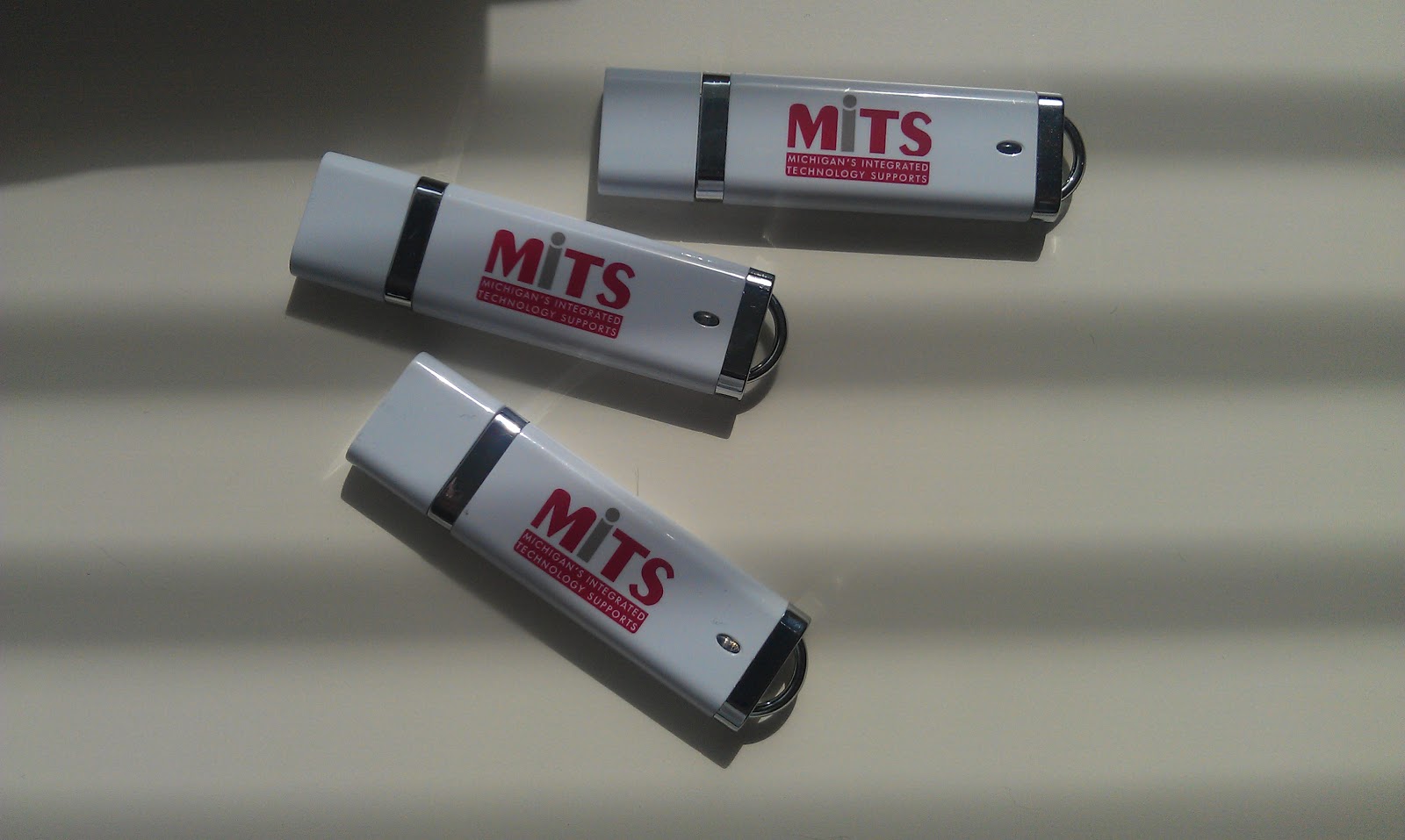
    So, over the past half decade people around the world have tried to develop ways for students to circumvent this obstructionism to inclusion and civil rights. The RSC-Scotland North+East developed the Access Apps project. Alec Couros of the University of Regina may have invented the term "Freedom Sticks" in 2007 to describe his efforts (I'm giving him credit, not lexigraphical historian being close at hand). And here in Michigan, we took Scotland's brilliant work, Americanized some of it, built a highly-accessible version of Firefox Portable to run on it, grabbed Alec's name, and put together the "MITS Freedom Stick" which you can download in zip form by clicking here (it goes on to a 4gb USB Flash Drive).

    Plugging this stick into "most any" USB port on a Windows (or Linux) computer will give a student accessible browsing, a full-featured text-to-speech system, links to a wide variety of free digital text sources, a scientific calculator, open source equivalents to Inspiration, Photoshop, Camtasia, Zip, writing supports, games, simulations, and a full version of Open Office - among other things.

    In other words, it makes using these computers, accessing the curriculum, communicating, possible for many students who, 17 years later, remain locked out of educational opportunity.

    So I encourage you to download our Freedom Stick or one from RSC-Scotland N+E and give your students the freedom to learn, the freedom to be independent, despite your school's intent to prevent that.

    But I have to give a warning... we used to say "any Windows computer," but recently we have discovered that some schools have teamed up with McAfee software to create a system which vandalizes (destroys) these drives when they are plugged into a computer. Now why any school would want to install malware designed to damage the property of others is beyond me, but I have to warm you that this stuff is out there. So before you give this tool to your students you may want to check with both your system administrators and your school district's/division/LEA administration, to make sure McAfee "virus protection" is either removed or adjusted.

    And one more note: Easiest way to dupe these drive (that I have found) is by using this little free tool from Germany - USB Image Tool. It allows you to create an image of your flash drive and reproduce it quickly and accurately.

    - Ira Socol

    1 - Section 504 of the Rehabilitation Act of 1973 as amended.
    2 - This letter was included in the "Assistive Technology/Accessible Workstation Campus Plan: Grand Valley State University" of March 31, 1999, which I wrote.
    3 - Grand Valley State University "Basic" Accessibility Stations 1999.
    Hardware:
    333 mhz desktops                                           $1,050.00 each
    128 mb RAM                                                  $   210.00 each
    8.4 gb hard drives (basic)                                $   175.00 each
    18 gb hard drives (advanced)                         $   420.00 each
    64 bit sound cards                                           $     95.00 each
    32x CD-ROMs                                               $     80.00 each
    17 inch monitors                                             $   226.00 each
    cable extensions for mouse, keyboard, mic, and headphones to allow easy front access
    both trackball and mouse available
    Logitech marble fx trackball         $     70.00 each
    Ergonomic Scroll-Mouse              $     20.00 each
    alternate keyboards available
    BigKeysPlus “abc” keyboard       $   169.00 each
    BigKeysPlus “qw” keyboard        $   169.00 each
    BigKeysMac “ABC” keyboard    available summer 99  
    2 keyboard adapter                       $     35.00 each
    BigKeys keyguard                                    $     95.00 each
    ORCCA keyguard/keyboard        $   140.00 each
    noise reduction headsets
    CyberAcoustics Headsets             $     20.00 each
    noise reduction headsets               $     26.00 each
    Spec. Noise reduction headsets    $     90.00 each
    CyberAcoustics “CyberHat”        $     20.00 each
    Software
    Windows98
    Office97
    Netscape Communicator
    Norton Anti-Virus
    TN 3270
    Zoom-Text Xtra Level 2 screen magnifier/reader (site license)
    Site License for 39 stations
    Unlimited License                    $7,750.00
    recommended so program could be installed on instructor stations campus wide, allowing screen magnification                              
    WYNN Reader (site license)
    Site License for 24 basic stations
    25 user WYNN reader                  $7,000.00
    IBM ViaVoice98 (site license)
    Single User
    ViaVoice Executive                      $   149.00
    39 users @ single price                 $4,291.00
    Triangle Accessible Calculator Software (shareware)
    Texas Instruments Graph-Link Software
    With cables                                   $     40.00 each                      
    Mathematica for Students                              $   140.00 each

    Sunday, February 6, 2011

    Beyond Disability

    I woke up this morning in a city which could not conceivably exist if technology did not allow humans to exceed their own capabilities.

    We can start with elevators. Yes, there are a few humans who can run up the stairs of the Empire State Building. But its a small group. And there's even a smaller group that can carry, say, furniture to the upper floors of any of thousands of buildings in New York City, or even just groceries or the lunch order.

    So we have technologies which enable us to exceed our abilities. And those technologies allow more of us to live and work together in ways impossible without technologies. And, in ways which do not require us to divide ourselves into people who can, (a) climb 3 flights of stairs, from people who can (b) climb 6 flights of stairs, from people who an (c) climb 9 flights of stairs.

    Everybody gets to push the button and go up.

    But we could go back further. New York City is a port built on an archipelago on the edge of a continent distant from its primary trading partners. Without first ships and then ships and bridges it could not ever have functioned as anything more than a great place to eat oysters.

    The "default" methods of human movement are, I suppose, "bipedal locomotion," crawling, climbing, and perhaps swimming. The default method of moving "goods" is to carry them. The default method of storing and transmitting knowledge are face-to-face speech and memory. The default methods of learning are trial and error and memory.

    "Assistive Technologies" - George Washington Bridge (background), rowboat and oars (foreground),
    because not everyone can swim the Hudson River.
    Anything beyond those "biologic basics" involve technology which increases human capacity and capability.

    So, am I awakening in a city of cheaters?

    Too many schools think so. They equate technological enhancement with cheating. Or, like those who understand why Oscar Pistorius might walk using artificial limbs - maybe artificial limbs which look like those they expect - but are very unsure he might run or race using limbs which seem unlike those they expect - they equate the unfamiliar technologies with cheating.


    Schools have long accepted print literacy, for example, which Socrates derided as a symbol of learning's descent into laziness, though that technology dramatically - and artificially (there is no "reading center" of the human brain) - enhances human capability. They have also come to accept eyeglasses, pens, artificial lighting, they have even accepted - well, demanded - math on paper, distrusting those who do it "naturally" - in their heads.

    In other words, certain "disabilities" are not "disabilities" at all, according to the "typical" school, and certain human "enhancements" are perfectly all right. So people are allowed to "cheat" in school regularly by storing information in books rather than memory, except on many tests, but if information is stored elsewhere, say, on the internet instead of a book, or if recall is needed during an artificial assessment process, it is "cheating." And people who might struggle with reading because of something different about their eyes are not disabled and get to use a whole variety of individual devices to help themselves, but people who might struggle with reading because of differences in brain use are disabled, and are often denied the use of their tools by teachers, school administrators, and state and federal politicians.

    Parents who have money enhance their children's natural learning path with everything from houses full of books, to computer access, to travel, to tutors. But children without resources are denied these same enhancements in schools.

    In other words, the idea of disability and the concept of enhancing the human is not just a social construction, but specifically a social construction of wealth and power. In New York the rich enhance their bodies via car ownership and access to cabs and limos. The poor lack those enhancements. Joel Klein wore eyeglasses and Cathie Black wears contact lenses to enhance their vision and reading as Chancellor of New York City's schools, but poor kids in those schools are denied the use of Text-To-Speech systems and audiobooks which would allow them to read. Arne Duncan daily enhances his human mobility and multitasking capabilities by being driven and flown around the country, but poor kids can't access tools which might get them to Duncan's "schools of choice" nor can they use the Blackberry which organizes Duncan's life in the schools he favors.

    Friday I was lucky enough to meet people from DARPA and the MIT Media Lab Biomechatronics Group and the New York Hall of Science and the NYU ITP program, and many other brilliant people, and we pretty much came to the conclusion that our entire understandings of disability and enhancement need to be reconceived.

    There are many examples of why, but I thought of one I personally observed. A high school non-reader I worked with was introduced to the WYNN Literacy Software. Within a month he was using this software to read at over 300 words per minute. Yes, in a month he went from not reading to exceeding the average adult fast reading speed by 20%. Thus, his tools, allowed him to "exceed capability." And certain educators were troubled by this. They actually wanted us to slow this boy down, so he would not have an advantage. These people never wondered about finding tools for the other kids which might maximize their abilities, rather, they were horrified when I suggested that this "special needs: kid now really needed to be in their gifted classes. He, like Oscar Pistorius, wasn't really doing it, his technology was, so he was "cheating."


    Most of those teachers and administrators wore eyeglasses, one had hearing aids. And so I was confused.

    Is "disability" a "thing" or an "idea"? Is "enhancement" anti-human or what humans do? And if we re-think these ideas, what does that mean for the way we operate schools.

    And with that I will travel 985 miles in the next three hours. Am I enhancing my human capabilities? And if I couldn't afford the plane ticket, would I be disabled?

    - Ira Socol

    Friday, May 15, 2009

    The "People First" Conundrum

    That old question of language - who it empowers, who it injures, who makes the decisions: Amy Bowllan, school librarian in New York City, Twitter-pal, and blogger for School Library Journal did an e-interview with me recently for her blog.

    Is people first language a positive step? Should we continue to encourage it? Read the interview, and for a balanced view read Goldfish (a favorite/favourite blogger) on The Language of Disability.

    All your thoughts are welcomed. At Amy's blog or here.

    - Ira Socol

    Thursday, May 7, 2009

    Margaret Soltan and Jim Crow

    I need to begin this by saying that Dr. Margaret Soltan of George Washington University is probably a brilliant teacher and a lovely woman. A perusal of her page on RateMyProfessor and her circle of friends suggest both. I also think that she is a fairly strong and effective writer.

    But I stopped reading her blog and her column long ago, and I would never take a class with her, despite the fact that we share many similar passions in the literature of the English language. I consider her a person who actively discriminates against people based on immutable characteristics of their humanity, a person who divides the world into first and second class citizens based on their similarity to herself. And I find that repugnant.

    Dr. Soltan is hardly the only member of a university faculty I place in this category, but by making herself a spokesperson for her position she has effectively become a George Wallace standing in the doorway.

    This is not an attack. It is an explanation. And I bring it up now because of a blog conversation inspired by Dr. Soltan at Easily Distracted. The blog at Easily Distracted starts with a typical Soltan hit-and-run against technology in the classroom. In this case quoting another prof who was incensed because a student in his class used a mobile to look up a word the prof had used in a lecture (yeah, really). Now, I'm historian and ethnographer enough to fully understand why a conservative Protestant theologian would object to any variation in the carefully linked structures of Calvinist Religion, Capitalism, and Gutenberg Technology. That's a received faith in authority and the unquestioned role of immutable text. And I understand that Dr. Soltan also teaches at a "private" university (though it is a "public university" by definition of Section 504 in terms of discrimination against students with disabilities because it receives - substantial - federal funds) and students have choices both within and without GWU...

    But I'm not speaking of the legal complexities here, I'm speaking of morality...

    I came to the Easily Distracted conversation because Carl Dyke at Dead Voles brought me in by referencing a blog post of mine on Technology and Equity in the conversation.

    Now, 18 months or so ago I challenged Dr. Soltan on this. I told her how allowing technology into the classroom as universal design made people with "disabilities" far more equal. How it eliminated the humiliation of unwanted and inappropriate disclosure (all said in detail in my post Humiliation and the Modern Professor). And how her anti-technology stance bordered on illegal re: the Americans with Disabilities Act and Section 504. She responded that, "of course," she would offer accommodation to "documented" students.

    Sew on that yellow Star of David

    That is not an acceptable response. When we adopt Dr. Soltan's attitude we make it very hard for a lot of students. Students are forced to choose between disclosure and using the tools they need, and I can tell you, from much evidence both 'scholarly' and personal, that many, many students will choose to avoid the tools which come with disclosure. And that many of those students fail.

    So, here's the impact of Dr. Soltan's opposition to the general use of technology in her classroom: (1) The further students are from being 'just like her' in abilities, learning styles, and learning preferences, the less likely they are to succeed in her class, because she requires that only her own technological tools be used. (2) Students with "disabilities" or significant learning differences are forced in to perhaps unwanted disclosure by her rules, which may have important consequences for their futures. (3) All students will be prevented from learning how their preferred toolbelt intersects with the world of English literature. Bad for all, disastrous for a specific class of students. Just as racial segregation was at the University of Alabama.

    And I am done with this - Dr. Soltan might be horrified if, in order to use 'the facilities' at a meeting, everyone had to get up and declare their gender and sexual preference. She'd possibly be offended if, in order to enter a restaurant, she was forced to declare her medical record. Perhaps she'd be bothered if we did not let her drive to campus without publicly declaring that she was too unfit to walk. In all these cases, we assume that people in society can make personal and tool choices without needing to announce personal information or beg permission from authorities.

    But Dr. Soltan is willing to do the equivalent to her students - not only that - she's willing to encourage others to do the same - in other words, she is willing to stand in the schoolhouse door and call the TV camera in to watch her block access.

    That's shameful.

    - Ira Socol

    A blog commenter asked why it was wtong to make all these issues public: I replied -

    "What I don’t want is anyone forced into unwanted disclosure in this society, especially in the US, where disclosure of disability can limit job opportunities and even access to health care. So, it is not important to me whether you take notes on a laptop because you have dexterity issues or problems forming letters, or issues with attention. I don’t need to know if you have digital books because you are dyslexic or have MS and can’t carry physical books, or even if you just prefer those.

    "We can talk preferences and diversity, absolutely. But I do not insist that students proclaim their disabilities, their sexual preferences, their gender, their racial make up, or even their birth socio-economic status. That information is welcomed and greeted without judgment when offered, but I do not teach - or live - in a world so perfect that I am sure no harm will come from these revelations.

    "Listen. I’m a doc student in a “Top Ten” School of Education’s Special Ed program (not a Prof -sorry), and there are still situations where I would rather appear insolent than disabled. So if asked why there is an earbud stretching from my laptop to my ear I might say, “I’m listening to music instead of you,” rather than, “the computer is reading to me.” Because I know that with certain university faculty, the former is sadly preferable to the latter."

    Tuesday, November 25, 2008

    The Four - or Six - Freedoms

    My dad used to tell me about "The Four Freedoms" - Franklin Roosevelt's goal for a post-World War world and his reason to fight.


    Freedom of Speech and Expression.

    Freedom of Religion.

    Freedom from Fear.

    Freedom from Want.


    "The Russians," my dad would say, "took the last two seriou
    sly. Everybody ate and invading armies were kept away [not that fear was wiped out]. The Americans worried about only the first two - and even then - not if you wanted to say you were a communist. The Europeans," he argued, "tried to do it all." This is part of what made my dad a classic "Social Democrat," me too.


    I think
    we, especially we in America - even as we celebrate the iconic Thanksgiving holiday - often forget the whole of what FDR was suggesting. These were not independent ideas, these Four Freedoms. They are interlinked parts of what makes a society whole. A person who is hungry lacks the essential ability to be free in other ways. A person in fear lacks the same. A well fed person who cannot speak her mind is a prisoner.


    "For there is nothing mysterious about the foundations of a healthy and strong democracy. The basic things expected by our people of their political and economic systems are simple." Roosevelt said, "They are:

    "Equality of opportunity for youth and for others.

    Jobs for those who can work.

    Security for those who need it.

    The ending of special privilege for the few.

    The preservation of civil liberties for all."

    We live in a world where too much fear, and too much want, are accepted. We also live in a world where expression of one's loves, thoughts, and intentions, are too quickly curtailed because they do not conform to some majority viewpoint. And we live in a world in which - in too many places - from Basra to American towns - systems of belief are imposed by those who believe that their religion is "the right one." And in every one of those cases, diminishing one freedom, diminishes them all.

    But there are other freedoms, implied in Roosevelt's great address but not explicitly named, and I would like to name them.

    Inherent in the Four Freedoms is freedom of opportunity. Not "Freedom of Opportunity" the way US Republicans would describe it - the right to be as rich and irresponsible as you want. But Freedom of Opportunity as the right to use your potential in a way that is yours. The right to make the most of yourself and be comfortable in your society. That implies freedom of human movement. It implies freedom live one's culture without intruding on others or being intruded on by others. And it implies two other things:

    Freedom to Learn - this seems so essential. People must have, as a right, access to the tools and information they need for their own education - at every stage of their life. And the must have, again, as a right, access to environments which support their educational needs.

    The Universal Declaration of Human Rights puts it this way, "Everyone has the right to education. Education shall be free, at least in the elementary and fundamental stages. Elementary education shall be compulsory. Technical and professional education shall be made generally available and higher education shall be equally accessible to all on the basis of merit." and, "Education shall be directed to the full development of the human personality and to the strengthening of respect for human rights and fundamental freedoms. It shall promote understanding, tolerance and friendship among all nations, racial or religious groups, and shall further the activities of the United Nations for the maintenance of peace."

    I'll put it another: Education must meet the student, and the student's needs. It must be accessible in every way - physically, by proximity or transportation, technologically, emotionally, intellectually, and strategically. Students have a right to have their learning needs treated as at least as important as the school's needs or the teacher's needs. They have a right to learn in the way that is most effective for them. And a right to develop at their own rate. They have a right not to be labelled, and a right not to be abandoned.

    Without that "Freedom to Learn" many of the other freedoms will remain permanently out of reach.

    Freedom to be Other than "Normal" - Humans must have an inherent right to be who they are. To not be forced to undergo unwanted "cures" for societally-imagined "disorders." To not be drugged for anyone else's convenience. To not be forced to waste vast amounts of time working on skills which are not just impossible, but are avoidable. Humans have a right to be "disabled" if that is ok with them. The human race need not be entirely white, English-speaking, Protestant, conventionally literate, walking, driving, passive learning, long - single-strand - attentional, "emotionally balanced" for best consumption, and with an IQ of 100 (+/- 10).

    "We" have a right to be a wheelchair user, and still move through our society. A right to be dyslexic, and still have information and communication available to us. A right to be deaf, without being forced to have implants in our brain. A right to have "an IQ of 70" and still be treated with respect - or the right to have "an IQ of 140" and not be bored to death and humiliated by school. A right to see differently, attend differently, learn differently without being separated from our peers and denied other basic rights and privileges. A right to be different and to not be treated as either a "nothing" or as an infant.

    And (why I have my Toolbelt Theory), humans have a right to know which tools exist which might help them lead full lives, and the right to access those tools, and the right to choose their own tools, based on their own needs and preferences.

    It is Thanksgiving (here in America) in a tough time (around the globe), and we might be tempted to lower our aspirations. But this Thanksgiving I'll remember that Franklin Roosevelt stood up - yes - he stood up, which wasn't easy - at a time when much of the world was shrouded in horror, and articulated a vision of a world, of a global society, that was worth fighting for. Let us do the same.

    - Ira Socol

    Most of FDR's speech in RealAudio (31 minutes)

    Last part of FDR's speech - The Four Freedoms - in RealAudio (4
    minutes)

    The first four images are Norman Rockwell's paintings of The Four Freedoms. The fifth is by William Ayton for the the United Nations. The sixth is from the Center on Human Policy, and is a T-shirt that Adam introduced me to.

    Alert! Please Vote! I'm trying to make the case to President Obama regarding investing in educational technology and universal design as part of the economic stimulus. It's not just great for schools, but "broadbanding" our schools and making them ICT-accessible would provide jobs and opportunities in every corner of the United States. Go to ObamaCTO and vote for Universal Technology for Schools (make it "3 votes" - you're allowed to do that), and keep this issue on the front burner.

    Sunday, April 20, 2008

    Passive Learning

    [a long reflection on the recent Inside Higher Ed debate on the internet in the classroom]

    There are always those who learn best by doing nothing.

    They sit back in their chairs and wait. The professor or teacher or minister stands at the front of the room and delivers received wisdom to them. They write that down in their notebooks. Then they go home, read the text line-by-line in prescribed order. Read their own exact notes on what the professor or teacher or minister has said. And then they are perfectly positioned to remember and repeat this knowledge.

    "An instructor’s job is not to entertain students. It is to convey knowledge that the students need — as determined by the institution that student chose to attend. Often the subject matter is not as entertaining as the Internet or a friend’s email message. But that is not the student’s decision to make. If the student knows better than the instructor and the law school dean about what they should study, then why are they attending law school? This modern sense of entitlement in students is frightening. They are there to learn under the tutelage of the instructor. The instructor and the institution know better – that is why they are at the front of the room and the student is in the seat. Let the instructors do their job as they see fit and acknowledge that the student’s role to listen." - "Peter"1

    The problem occurs when schools - rather than churches - embrace this style of learning above all others. Because the problem with this type of passive learning, of receiving received wisdom, is that it does not work unless teacher and student share the same exact world view. If the "systems" can connect exactly, and the desire is to replicate the teacher within the learner, then... yes, open the connection and let the data pour from one vessel to another.

    Think about this: Who succeeds? Who are the classroom stars? Back in third grade it was the quiet girls who were most like the female teacher (herself a former English major from a "good family") - the ones who "loved to read," who were "good at paying attention," who "worked hard," who had the "support of their family at home."

    In high school it was probably the boy who most resembled each teacher - the "studious types" who were "really interested in the subject," and came with a "natural curiosity," and who, outside of school, "focused on their schoolwork not the other stuff."

    In universities it is the students who will "grow up" to be professors and who will be, in a dozen years, indistinguishable from their former teachers.

    "Reality: strongly-motivated students, with strongly-motivated families, make education happen." - "Buzz"1

    And in all of these cases the perception will be that these students are succeeding because they are superior, because (as "Buzz" above puts it) they come from superior families, because they are "the elect." How gratifying it must be to the self-perception of the faculty that those who are the most superior students are those most like themselves.

    This is the important sub-text of the conversation at Inside Higher Ed regarding the University of Chicago Law School (Hey, you! Pay Attention!). Students such as "Ryan G" who says, "If you see a class with a some raptly paying attention to the instructor while others appear distracted, you may also be seeing different learning styles. Sorry, but not everyone learns by watching a talking head for 50 minutes. I *can’t* learn that way and never have been able — which almost resulted in me not graduating high school. However I did finish high school, college, and eventually medical school (back when we didn’t have laptops in class.) Though I finished med school only by never actually going to lecture, running the note-service, and teaching myself in a way I can learn. (And despite not attending the talking head shows I graduated in the top of my class from a top 20 US medical school.)"1 are wrong even if they have succeeded, because they have not followed that "true path," they have not suffered in the "right ways," they are simply not enough like those who teach them.

    "The best training a quality attorney can have is attending class with a professor whose teaching style forces the student to dig deep for the importance of the message when every cell in the body is screaming to be released from the tortures of boredom." - Kathy Anderson, Director, Diversity & Equity at Cal State University - Monterey Bay1

    This is the Protestant, ableist message. There is one route to salvation, and that path runs straight through conformity and obedience. And only conformity and obedience, only staying on the one straight path, will prove that you are a member of the elect, that you have been chosen. That path is hard, and difficult, and uncomfortable, as it must be because that is the way we filter out those who do not belong.

    "I feel compelled to ask the following question: what is wrong with having to listen to a boring professor or a boring lecture? Plenty of us had to do that when we were students. A lecture may not have provided us with instant gratification, but we were taught to respect the professor no matter how boring his/her lectures were." -"gianstefano1

    What if students have a different world view?

    A friend of mine recently talked about the class she is teaching in diversity in education. She told me about the conversations she had with her students regarding religion, and how difficult it was to get the conversation started. I told her how important this conversation was for teachers and pre-service teachers, and I suggested that she say this to her students:

    "What if a large number of your students came from a culture where you went to church according to your schedule, not just at specific times determined by the church? Might they have a different view of the school day and the school schedule?"

    "What if a large number of your students came from a culture where it was considered perfectly acceptable to stare off at the walls and windows during church services? Might they have a different idea of what 'paying attention' meant?"

    "What if a large number of your students came from a culture where no one read individually in church? Where people moved all the time during the service? Where art, music, taste, and smell were all considered essential parts of religious learning? Might they have different ideas about reading, sitting in class, or how curriculum is delivered?"

    Of course a large number of their students will be from a culture just like that - Catholics. That little group that makes up about 25% of the US and perhaps a third of children in public schools.

    Remember, John Calvin and other Protestant founders railed against those ornate churches with their 'teaching art.' They railed against the openness of the Mass. They railed against the complex and diverse delivery system of Catholic dogma. They wrote everything down in books which they handed out to ensure that everyone received the exact same revealed word. They set worship times and insisted on attendance. They held services in plain white buildings. And, yes, they knew that some children were born pre-destined for heaven while others were born pre-destined for hell.

    And when they got their hands on public education in North America - beginning in 17th Century New England - they made schools look and operate just like their churches. Catholic multi-tasking was most definitely "out," as were Catholic flexibility, the Catholic notion that celebration (Saint's Days, even Christmas in those early days) could be educational, and subjects like art and music. This system of operation has changed very little over the ensuing centuries.

    In fact, if you listen to those who are "born right," and who are thus entitled to the passive learning, the only thing that has changed is the corruption of the student body which has strayed ever further from the perfect path.

    "Mr. Socol, students used to know how to pay attention, even when the lecture was boring, and still managed to learn something. Adding cell phones, ipods and laptops for todays students who were born for the “short attention span theater", is throwing water on a grease fire. Students seem to no longer have the skill to be able to focus on one thing at a time. Blaming the lecturer is the lazy persons copout." - "Bored by lazy students"1

    vs. Active Learners


    So, if a student brings a different style, different methods, different intentions to the classroom, it is understood as a moral failing and a threat to the established order, and, perhaps, a threat to God. The argument is rarely about what is being learned, or about how the student is developing, and it is almost never about a student's right to determine what they need educationally, it is always about "following the rules"

    "Maybe they would film it on their cell phones and post it on You [T]ube so their friends who cut class could watch it during some other class. I think this is why students aren’t learning: they aren’t paying attention. Unless it is part of the lesson, nothing that isn’t class work should be allowed during class time." - Dr. Jay Bernstein - Kingsborough Community College1

    The obvious question for Dr. Bernstein is why not, "film it on their cell phones and post it on You [T]ube so their friends who cut class could watch it during some other class"? As Jerry Pattengale, AVP for scholarship & grants at Indiana Wesleyan University, noted, "I assume that few classes over 100 can make a strong case for the need to have live professors v. YouTubing lectures—if the professor still remains available online and in special on-campus gatherings."1 Does it really matter if I attend the class at the required time or get what I need from it in a way, at a time, when it works better for me? What if I, as a student, decide that I have, or need, a different path, or a different timeline, to knowledge acquisition? What if I, as a student, need to filter this "received wisdom" through my own world view, or through a knowledge base different from that of the instructor? What if my way of learning requires multi-tasking, or requires time spent - effectively - staring at the stories in the stained glass windows at times, even when the 'priest' is speaking? Does it matter to the professor, the teacher, the school, the university if I make those decisions for myself?

    Apparently it does, because in the view of the entitled passive learner, the class instructor has received his or her powers in much the same way as the old kings of France - by divine right:

    "The classroom is the professor’s domain. It is his or her kingdom. Their will is the law. If you don’t like it, do not take that class. Can’t change class? Then go to another school. Otherwise, stop whining. Buckle down. Read your cases. Pay attention. Handwrite your notes. Learn what the professor wants you to learn." - "John3L Law Student"1

    It is all there in this future lawyer's words. The power is in the hands of those who have received it. Follow the path or go to Hell. And following the path requires absolute commitment to the ways of the elite, the ways of the past. Sit down. Shut up. Read your book. Write that down one-hundred times.

    A fight against faith...

    A friend of mine once told the story of being both a Catholic and the graduate of a Catholic university and arriving as a new faculty member at a Christian college. One of the first courses she was assigned to teach included, as part of the curriculum, the study of The Reformation. She called up a friend and said, "I don't know what to do with this, what do I really know about he Reformation?" "What do you know?" the friend asked, "You know that we're against it."

    When I first began graduate school I followed an adviser's advice and joined a list-serve called "SpEdPro," a collection of academics involved in American "special education." (for a sense of the attitude which prevails on SpEdPro see this site by one of its active members) After just two months I became embroiled in a huge battle because I expressed "post-modern" thoughts on the subject of "research proven solutions" for students with differences. My arguments that this kind of prescriptive solution set blamed the student and not the school whenever a disconnect occurred were roundly denounced as heresy. I was a relativist witch in this modernist Salem, arguing against all notions of truth. Like a self-styled latter day Roger Williams I fled - to this blog (notice the name). Like Rhode Island, it is a small place. Unlike Rhode Island, I can't yet see my efforts as a success.

    The problem is that this is a faith-based fight. If you can believe in the superiority of the passive learner, of received wisdom, you will never be able to see the rights of students who are different - whether they arrive from Catholic backgrounds with weird notions of time, movement and distraction, or who come from families with African or Caribbean or South American backgrounds with odd ideas about reading as a community activity, or who appear at school with brains genetically established differently in terms of attention, or who may have been born with differing capabilities in reading, or writing, or learning speed. You will never see that they are equal humans who have the same right to success.

    You may see them as charity cases worthy of your sympathy as long as they "try hard enough" to act, to be, just like you. But you will not see them as equal. You will not see them as "Holy." You will not see them as being on the correct path to the light.

    On another blog someone calling himself "Dave Stone" said this to me: "Ira–what you’re suggesting sounds to me like "defining deviancy down," taking unacceptable behavior and making it OK by lowering the standards of what’s acceptable. I can buy your Calvinist argument to a point, but this isn’t a matter of mere WASPy repression. There’s a functional reason why Protestants wanted people to shut up and pay attention: being present for the Presence and the ritual mattered less, listening to what was being said mattered more. It seems to me that a college classroom is more about paying attention to what’s going on than basking in the glory of the professor."2

    And this is the mistake Protestants often mistake about Catholicism and educators too often make about students who are different. They believe that "being present for the presence," and the ritual itself, are not educational, are not dialogue. They believe that the only actual way to learn is to "shut up and pay attention." They can not even imagine that one might ask deep questions while staring at the images in the stained glass, or that the process of moving through the Stations of the Cross could include intellectual interaction, or that considering the Eucharist can be as essential educationally as reading today's chapter and verse. They can not imagine that the smell of incense or the light of the candles has true value. They, of course, can not conceive that showing up for an afternoon mass is as valuable as getting up early (with its assumption that you haven't spent Saturday night in an Irish pub), and sitting in silence alongside all of your neighbors, each reading the exact same text at the exact same moment. Failing to live up to the Protestant ideal makes you, at best childlike (this is why American Protestants send 'Christian Missionaries' to entirely Catholic nations), at worst, demonic.

    "It may be over-parenting, but 18-21 year olds, are still in need of how to be a student and how not to be a plugged-in, distracted, slave to technology. You go Chicago!" - "Kristy, Compass Montessori High School"1

    "
    Yo — U-Chic is an Ivy-level law school. The Socratic method. Like getting an immediate “F” if you’re not prepared for class. The real thing. Not a bunch of Billy Ayers-types, singing Kumbaya and holding hands. Professional stuff — like passing the bar exam and impacting millions of people." - "KCG"1

    "I applaud the move by the University of Chicago Law School to preserve the sanctity of the space of the classroom for teaching purposes." - Steve Katsinas, Professor at University of Alabama1

    Two last thoughts:

    First, I sat at a Seder Saturday night and listened to the story of "The Four Sons" and considered how, in this most ancient of Jewish celebrations the idea that education is for all, and that, in order for education to be for all, it must be individualized, is enshrined. I also noticed that in this holiday, probably the longest-celebrated Holy Day in the western world, ritual and props and tastes and smells are all used to support a communal literacy approach to learning.

    Second, I remember sitting in St. Patrick's Cathedral in New York not so long ago. I had brought a friend who was new to the city in to see, and a violent storm had broken out at the moment the 3 o'clock Mass was beginning. So we sat down and joined. We joined an incredibly diverse crowd, which, among other things, included every conceivable age and dozens of languages. Yet, we were all part of this, held together by the thin yet powerful threads of ritual but also supported in our own needs by the stunning diversity of teaching methods surrounding us. Yes, I heard the priest, but just as much I let my eyes move about the space, finding what I needed in the art, in the vastness of the Gothic space, in the sounds around me. Perhaps I was not learning what everyone else was. Perhaps I was only learning what I was ready for at that moment, and what was essential to me. That, I realize now, is a stunningly different concept of education than the one we meet in our schools, but I wonder - is it truly less valid?

    If my education had been individualized from the start - as Judaism suggests - might I not be ready to truly learn on my own - as the cathedral suggests? Might that not be a better way?

    This is not a debate that I will win. As Max Weber so clearly put it, capitalism and Protestantism march hand-in-hand. And we live in a culture dominated by both. Other arguments will always be infantilized, and labelled as odd and exotic - just as all of our kids, and all of us, who are not passive receptors of knowledge are labelled this way.

    But even unwinnable fights are sometimes worth fighting. That battle against The Reformation did not quite work either - surely not in the self-proclaimed "advanced" nations - but it did preserve an alternative, and it did allow the western world to see a choice.

    Maybe that is enough of a reason to keep arguing.

    - Ira Socol

    Related posts - Considering Universal Design, Not Getting to Universal Design, Humiliation and the Modern Professor, Technology and Equity.

    1 quotations are from those commenting on the Inside Higher Ed article: Hey, You! Pay Attention!
    2 from the comments on a post at the University Diaries blog

    The Drool Room by Ira David Socol, a novel in stories that has - as at least one focus - life within "Special Education in America" - is now available from the River Foyle Press through lulu.com

    US $16.00 on Amazon

    US $16.00 direct via lulu.com

    Look Inside This Book


☝