What, exactly, prevented a Penn State University graduate and grad student, from intervening to stop a crime in 2002, or from calling the police?
When Mike McQueary looked into the showers in Penn State's football team locker room that year, and saw a middle age man having sex with a 10-year-old boy, he chose to do nothing.
Why?
And, next question. When young Mr. McQueary told his faculty supervisor about his decision to do nothing the next day, what caused his supervisor, the highest paid public employee in the state of Pennsylvania, to do only the minimum. Actually, it is worse than that. The faculty supervisor not only did the minimum, he promoted the ethically challenged Mr. McQueary to a full time job.
When Mike McQueary looked into the showers in Penn State's football team locker room that year, and saw a middle age man having sex with a 10-year-old boy, he chose to do nothing.
Why?
And, next question. When young Mr. McQueary told his faculty supervisor about his decision to do nothing the next day, what caused his supervisor, the highest paid public employee in the state of Pennsylvania, to do only the minimum. Actually, it is worse than that. The faculty supervisor not only did the minimum, he promoted the ethically challenged Mr. McQueary to a full time job.
 |
| Kitty Genovese and where she was killed, while many watched, and no one even called |
 |
| The Penn State University football locker room showers |
And no one in positions of power at Pennsylvania State University bothered to waste a minute of their precious time looking to help the victim of this crime. They were, as sports columnist Jason Whitlock notes, looking after their brand and their profits instead of looking out for children.
But why? Why would all these very educated men, or men and women, be so institutionally compliant that basic human morality was abandoned?
We've asked this question before, about Enron, about the Atlanta Public Schools, about Bank of America, AIG, Goldman-Sachs, the Bush Cabinet of 2002-2003, all places where people watched crimes in progress and did nothing - in sad Kitty Genovese style - but rarely have we had such a classic public illustration of compliance over-ruling basic social instincts as we have in the Penn State Child Sexual Abuse case.
I'm not going to spend too much energy here working on understanding the "criminal mind." I've spent enough time as a police officer trying to grasp the "why" behind truly deviant behaviour. My only guess is that some in any society deeply misread the selfishness limitation line which allows a society to exist. We either learn pretty early that we don't grab for everything we want, or we end up as thieves, rapists, Republicans, Tories, or Wall Street/City executives.
So, even if I could imagine why a guy like Jerry Sanduskey wants to pursue sex with people not mutually interested, I can't quite grasp where his social learning went wrong. But I can look around, I can see that Sanduskey lived in an environment, an environment built by his society, in which older men got to exercise absolute power over boys. He also lived in an environment which encouraged different rules, and different privileges, for different people. And he lived in an environment in which celebrity often appears to trump responsibility. So, nothing in Jerry Sanduskey's adult life was helping him to learn late lessons on living in a society which he had failed to absorb early. In this, he closely mirrors people like John Thane, the ex-Merrill Lynch chief executive. If Sanduskey or Thane missed out on "the rules" as two-year-olds, nothing in either of their environments was going to help them learn.
As for Paterno, well, imagine yourself learning that a 10-year-old was being abused by someone you knew in your - office, workplace, school, shop - and now ask yourself if you would do nothing more than call the next person up the line, and never ask another question? Arrogance? Disinterest? I don't know, but perhaps not the public face your organization desires.
What really interests me is then graduate assistant coach, now wide receivers coach, Mike McQueary. I do wonder, as Philly.com columnist John Baer does, "why a young, strong 6'4" recently former Division I athlete didn't stop the rape of a child in progress"? But I also know - those years as a cop again - that some people are interventionists by nature and others are not...
Yet, the biggest question is, why this young man, trained as a football quarterback, being groomed as a future football coach - a kid steeped in the leadership ethic of sport in education - did not even call the police?
But why? Why would all these very educated men, or men and women, be so institutionally compliant that basic human morality was abandoned?
We've asked this question before, about Enron, about the Atlanta Public Schools, about Bank of America, AIG, Goldman-Sachs, the Bush Cabinet of 2002-2003, all places where people watched crimes in progress and did nothing - in sad Kitty Genovese style - but rarely have we had such a classic public illustration of compliance over-ruling basic social instincts as we have in the Penn State Child Sexual Abuse case.
I'm not going to spend too much energy here working on understanding the "criminal mind." I've spent enough time as a police officer trying to grasp the "why" behind truly deviant behaviour. My only guess is that some in any society deeply misread the selfishness limitation line which allows a society to exist. We either learn pretty early that we don't grab for everything we want, or we end up as thieves, rapists, Republicans, Tories, or Wall Street/City executives.
So, even if I could imagine why a guy like Jerry Sanduskey wants to pursue sex with people not mutually interested, I can't quite grasp where his social learning went wrong. But I can look around, I can see that Sanduskey lived in an environment, an environment built by his society, in which older men got to exercise absolute power over boys. He also lived in an environment which encouraged different rules, and different privileges, for different people. And he lived in an environment in which celebrity often appears to trump responsibility. So, nothing in Jerry Sanduskey's adult life was helping him to learn late lessons on living in a society which he had failed to absorb early. In this, he closely mirrors people like John Thane, the ex-Merrill Lynch chief executive. If Sanduskey or Thane missed out on "the rules" as two-year-olds, nothing in either of their environments was going to help them learn.
As for Paterno, well, imagine yourself learning that a 10-year-old was being abused by someone you knew in your - office, workplace, school, shop - and now ask yourself if you would do nothing more than call the next person up the line, and never ask another question? Arrogance? Disinterest? I don't know, but perhaps not the public face your organization desires.
What really interests me is then graduate assistant coach, now wide receivers coach, Mike McQueary. I do wonder, as Philly.com columnist John Baer does, "why a young, strong 6'4" recently former Division I athlete didn't stop the rape of a child in progress"? But I also know - those years as a cop again - that some people are interventionists by nature and others are not...
Yet, the biggest question is, why this young man, trained as a football quarterback, being groomed as a future football coach - a kid steeped in the leadership ethic of sport in education - did not even call the police?
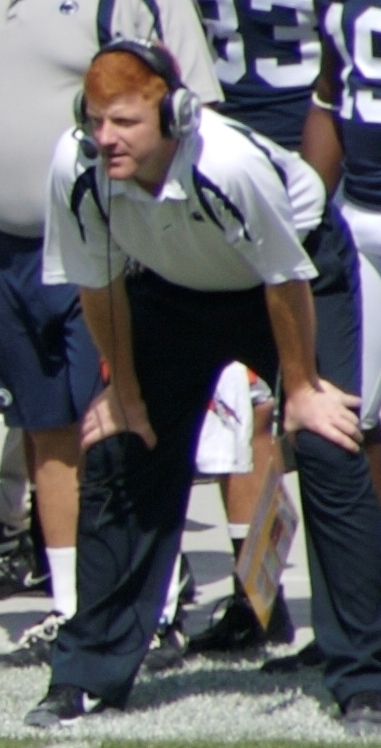
Mike McQueary, man of action in 1996. Six years later, witnessing a major crime,
he did nothing, then went home and asked his dad what to do...
he did nothing, then went home and asked his dad what to do...
 |
| Mike McQueary Wikipedia Commons Photo |
This was not one of those, "uh, not sure it matters" kind of thing McQueary watched that afternoon in 2002. It wasn't a friend driving five miles an hour over the speed limit, or someone having a few too many drinks, this was - first - one of the "big crimes." In New York City's Police Academy we were told that there were only five crimes for which you could use deadly physical force to "prevent or terminate." The acronym was "Mr.Mrs." - Murder, Robbery, Manslaughter, Rape, (forcible) Sodomy. McQueary observed one of those, and - second - he knew the victim of this crime to be a child.
What, one wonders, would McQueary have to see which might get him to call 9-1-1?
Or, the real question, why did Mike McQueary not call police within this "educational environment" when - and I'm guessing here - he would probably have intervened if he had observed the same scene in another place, say, in a park or library rest room?
I ask, because I often see people in education afraid to intervene, afraid to confront, afraid to report, when something involves people within the system. I spent years hearing about "the blue wall of silence," when I was a cop, but I knew then that, at least a New York City cop, was far more likely to turn in another cop, than lawyers or doctors were willing to turn in their peers. When I became involved in K-12 education, I remember saying, "a cop is far more likely to turn in a fellow bad cop (our term back in the 1980s was a holdover from the very old days of cheap phone calls, you, "dropped a dime" on someone) than a teacher is to do the same." And I thought, hell, cops faced more risk. You knew the person you were turning in had a gun.
We also confronted our peers a lot. I remember a fistfight breaking out in the "4-7" locker room over mistreatment of a prisoner. I remember a bunch of us standing in the street telling a narcotics officer we'd never come back him up again because of the crap he was pulling on people on the street. And, well, woe to anyone, of any rank or title, who messed with a child.
But somehow, in education, we choose "respect," "stability," and "caution," over action and intervention. Is it because a different personality type chooses education? Is it because education chooses different personalities? Is it because we train people, as Mike McQueary was trained, not to doubt? Not to challenge?
In every school I go to, people know if someone is causing harm to kids. But, in almost all of those situations, that person is not challenged, not reported. And if they are reported - counter to the anti-union nonsense floating through the media these days - the reports are made to respected Joe Paternos, who do nothing, because they too are afraid to doubt and challenge.
"We worship corporations and institutions. Our Supreme Court granted them First Amendment rights. The Fourth Estate, the alleged watchdogs of democracy, acts as their mouthpiece," Jason Whitlock wrote yesterday. "There should be no surprise that protecting Joe Paterno, Penn State, Happy Valley and Linebacker U — profit-generating institutions at the core of big-time college athletics’ amateur myth — appears to have taken precedence over the protection of children. It’s the era we live in. Institutions are valued more than human beings."
This isn't just true at Pennsylvania State University, or in their football program, it is true in far too many places. And in far too many places we train young people, like Mike McQueary, in our cultures of compliance, because we worship institutions, and we crave stability, and we place myths above human needs.
Joe Paterno and those above him at Penn State have been revealed for who they are. People who would choose to ignore "a 1998 case involving allegations of sexually inappropriate behavior by Sandusky investigated by campus police, the Centre County district attorney and the Department of Public Welfare," people who would not even look for the child victim of rape, people who would see these crimes as columnist Baer writes, as "collateral damage, I suppose, to maintaining the university's aura."
"We worship corporations and institutions. Our Supreme Court granted them First Amendment rights. The Fourth Estate, the alleged watchdogs of democracy, acts as their mouthpiece," Jason Whitlock wrote yesterday. "There should be no surprise that protecting Joe Paterno, Penn State, Happy Valley and Linebacker U — profit-generating institutions at the core of big-time college athletics’ amateur myth — appears to have taken precedence over the protection of children. It’s the era we live in. Institutions are valued more than human beings."
This isn't just true at Pennsylvania State University, or in their football program, it is true in far too many places. And in far too many places we train young people, like Mike McQueary, in our cultures of compliance, because we worship institutions, and we crave stability, and we place myths above human needs.
Joe Paterno and those above him at Penn State have been revealed for who they are. People who would choose to ignore "a 1998 case involving allegations of sexually inappropriate behavior by Sandusky investigated by campus police, the Centre County district attorney and the Department of Public Welfare," people who would not even look for the child victim of rape, people who would see these crimes as columnist Baer writes, as "collateral damage, I suppose, to maintaining the university's aura."
But we cannot let the questions stop there. We all need to ask ourselves if we are training Mike McQuearys in our schools. And if we are, we need to decide just what we are going to do about that.
- Ira Socol


No comments:
Post a Comment