Accessible web sites are all too rare, and ones that are truly easy to work are even rarer, so I want to celebrate the Royal Agricultural College at Cirencester and their fabulous web site.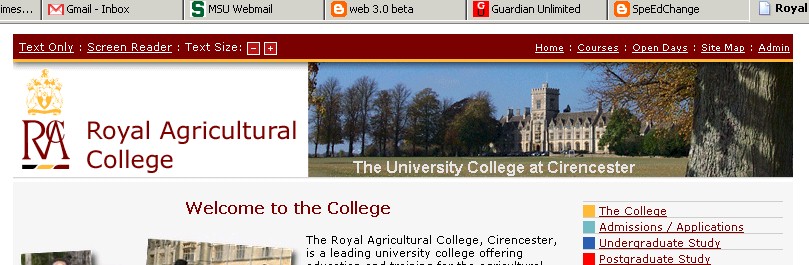 Every page on the RAC site is topped by an accessibility bar that allows every web visitor to choose between the graphical version, a plain-text version, or a version designed specifically for screen readers. There are also quick buttons to change the type size.
Compare this to the typical educational site (allow me to use my own Michigan State University as an example). MSU's site does contain an accessibility statement, but it is in the very last line of the page - a screen reader user would have to allow a default reading of the entire page in order to come to this item. RAC does it correctly, with the choice in the upper left-hand corner where even a fully blind-browser or screen reading system (such as JAWS) would find it instantly.
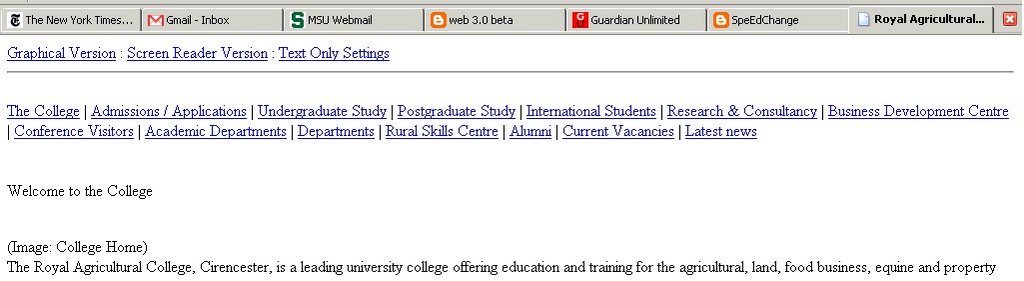 The automatic creation of accessibility choices - without any need for any training or discovery time - is what makes this a perfect solution. The first time that I saw it, after communicating with one of the professors there about accessibility issues,
  I realized "this should be the model."
The challenge is to look at your school or university's web site. How easy is it to get to the accessibility options? How easy is it to make the type bigger? Could you operate your site with a screen reader and the monitor turned off?
Remember. This isn't just about students - schools often say, "we don't have any blind students." But what about parents? guardians? relatives? prospective students? or even the citizens 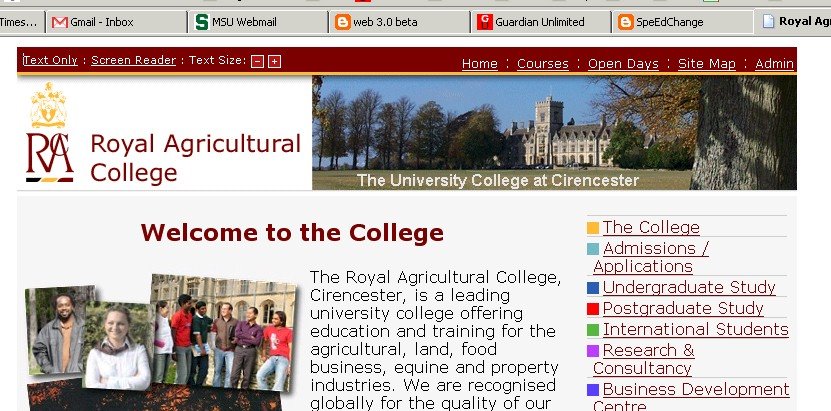 who fund your school or grant it tax-free status? Someone in your school community needs these accommodations. And if they need the accommodations, they need to be able to find those accommodations without first taking a course in navigating your website.
For web access advice and tutorials you may want to start at WebAim and WC3, the Web Accessibility Initiative. To test sites, use CynthiaSays... and open your digital doors to everyone.
- Ira Socol
Thursday, October 26, 2006
Web Access - the right way

Subscribe to:
Post Comments (Atom)
Popular posts
-
 There are two big things going on in the world this week, one fifty years old, one absolutely current, which should keep your students talki...
 -
Procter&Gamble has the tagline very wrong, but their Olympics ads explain what is crucially wrong with the argument espoused by those w...
-
 Happy Valley/Omelas, Buffalo High School, the Occupy Movement, and our Classrooms Back in 2008 I wrote a post about " Constructing Disa...
 -
 There have been two "grass roots" movements spring up in the United States since President Obama was elected. The "Tea Party...
 -
 I was working on a lesson with sixth graders and middle school teachers in doing math without any tools, just in your head. Not memorizatio...
 -
Telling stories without words. George Méliès, 1902 "Enough is enough. No more computers, cameras or consoles. No more watches, necktie...
-
 part one part two afterthought Bill Gates is one of the most influential people in American education, by virtue of the way ...
 -
It's nice out, and I'm tired of being inside and being angry. The philosophy of education can make my head hurt. And so can the low ...
-
There are many young people demonstrating in the world today. All across the US and in many other nations people are building the Occupy Mov...
-
This was a long, long time ago... What happened in October 1929? Why were income taxes very high in 1919? Your Republican member of Congress...


No comments:
Post a Comment